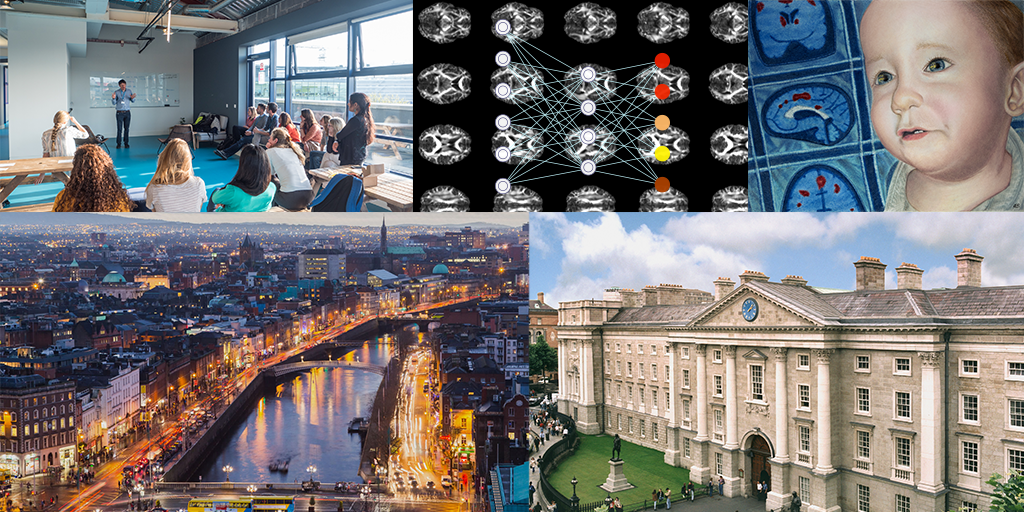
Five Ways to Join the InfantNeuroAI Team!
Infants are acquiring the brain representations that form the foundations of cognition. These representations are powerful: they let a child go on to master many tasks with remarkable speed. The InfantNeuroAI project aims to measure these developing representations, using awake infant neuroimaging with fMRI and OPM-MEG, and to model the developmental process using computational models from AI.
The project has three goals. To better understand infant cognition. To develop neuroimaging methods that can detect disrupted function after neonatal brain injury. And to identify new, more energy-efficient learning algorithms that could reduce the economic and environmental cost of AI.
Everyone on the project is involved end to end: setting up the imaging, designing experiments, acquiring data, analysing it, building computational models, presenting the work and writing it up. You will do all of this with Professor Rhodri Cusack and an interdisciplinary team of neuroscientists, cognitive scientists, neuroimagers and AI engineers.
The project has three goals. To better understand infant cognition. To develop neuroimaging methods that can detect disrupted function after neonatal brain injury. And to identify new, more energy-efficient learning algorithms that could reduce the economic and environmental cost of AI.
Everyone on the project is involved end to end: setting up the imaging, designing experiments, acquiring data, analysing it, building computational models, presenting the work and writing it up. You will do all of this with Professor Rhodri Cusack and an interdisciplinary team of neuroscientists, cognitive scientists, neuroimagers and AI engineers.
Postdoctoral Fellow in Awake Infant OPM-MEG
You will lead the establishment of awake infant OPM-MEG in the lab, using our CERCA system, and carry that work through to experiments, analysis, modelling and publication.
You will need good coding skills and expertise in at least one of the following, with a willingness to develop the others:
Closing date: 4 October, 2026.
Further details and how to apply: https://cusacklab-web.s3.amazonaws.com/infantneuroai_2026_researchfellow2_opm-meg.pdf
You will need good coding skills and expertise in at least one of the following, with a willingness to develop the others:
- Cognitive neuroscience
- OPM-MEG, MEG or EEG
- Computational modelling using deep neural networks
Closing date: 4 October, 2026.
Further details and how to apply: https://cusacklab-web.s3.amazonaws.com/infantneuroai_2026_researchfellow2_opm-meg.pdf
Postdoctoral Fellow in Awake Infant fMRI and NeuroAI
You will lead the establishment of awake infant fMRI on our Siemens 3T Prisma, and use the resulting data to test and develop deep-neural-network models of how infants learn.
You will need good coding skills and expertise in at least one of the following, with a willingness to develop the others:
Full time for two years from January 2027. Salary €47,273–55,399 per annum, with pension contribution, PRSI social insurance and annual leave.
Closing date: 4 October, 2026.
Further details and how to apply: https://cusacklab-web.s3.amazonaws.com/infantneuroai_2026_researchfellow1_fmri.pdf
You will need good coding skills and expertise in at least one of the following, with a willingness to develop the others:
- Infant cognitive neuroscience
- Neuroimaging with fMRI
- Computational modelling using deep neural networks
Full time for two years from January 2027. Salary €47,273–55,399 per annum, with pension contribution, PRSI social insurance and annual leave.
Closing date: 4 October, 2026.
Further details and how to apply: https://cusacklab-web.s3.amazonaws.com/infantneuroai_2026_researchfellow1_fmri.pdf
Three PhD Scholarships in Awake Infant fMRI and NeuroAI
These scholarships offer rich training in neuroimaging methods, developmental cognitive neuroscience and computational modelling with deep neural networks. Working with Professor Cusack and the wider team, you will take part in the full research cycle using awake infant fMRI and/or OPM-MEG.
You will need a Bachelor's degree in psychology, cognitive science, computer science or a related field, good coding skills, and expertise or strong interest in:
Closing date: 4 October, 2026.
Further details and how to apply: https://cusacklab-web.s3.amazonaws.com/infantneuroai_2026_phds.pdf
You will need a Bachelor's degree in psychology, cognitive science, computer science or a related field, good coding skills, and expertise or strong interest in:
- Cognitive neuroscience
- Neuroimaging
- Infant development
- Deep neural networks
Closing date: 4 October, 2026.
Further details and how to apply: https://cusacklab-web.s3.amazonaws.com/infantneuroai_2026_phds.pdf
Why join us?
The science is at an inflection point. For the first time it is possible to record brain activity from awake infants at scale, with fMRI and now OPM-MEG, and to compare it directly against deep neural networks trained on the same kind of experience infants get. Our recent work has shown that infants already have rich visual categories in ventrotemporal cortex by two months (Nature Neuroscience, 2026), that models trained on infant views predict infant visual cortex (2025), and that visual experience shapes connectivity between occipital and non-visual networks (eLife, 2026). InfantNeuroAI, funded by a €3.5M ERC Advanced Grant, is where we take this next: mapping how foundational representations are learned across the first year, and using what we find to build learning algorithms that are more data-efficient than today's AI.
You'll own a question, not a task. Everyone on the project works end to end: designing experiments, acquiring data with infants, building models, analysing, writing and presenting. The team mixes neuroscientists, neuroimagers and AI engineers, and the postdocs will each lead a new capability in the lab (awake infant OPM-MEG, awake infant fMRI with NeuroAI), with PhD students developing their own projects within the programme.
The tools are here already. The Trinity College Institute of Neuroscience houses a research-dedicated Siemens 3T Prisma, a CERCA OPM-MEG system and an NVIDIA GPU cluster, alongside 60 research groups and around 250 scientists. Our team has scanned more than a hundred awake infants, and we have close links with maternity hospitals in Dublin and centres across Ireland, so recruitment and clinical translation are well established rather than something you'd be building from scratch.
You'll be well supported. Postdoctoral posts are full time for two years with a salary of €47,273–55,399, pension, PRSI and annual leave. PhD scholarships run four years with a €25,000 annual stipend, fees paid and funding for conference travel. Lab members present regularly at ICIS, FIT'NG and computational neuroscience meetings, and we have a track record of supporting people through visa applications and international moves. Former lab members have gone on to leading groups around the world, Faculty positions and into the tech industry.
Dublin is a good place to do this. Trinity sits in the centre of a walkable, English-speaking European capital with a large tech and AI sector, direct flights across Europe and North America, with strong vibrant communities at TCIN and the School of Psychology community.
We welcome applicants of all backgrounds and career paths. If you're not sure whether your experience fits, get in touch with Tamrin Holloway [email protected] for an informal conversation before applying.
You'll own a question, not a task. Everyone on the project works end to end: designing experiments, acquiring data with infants, building models, analysing, writing and presenting. The team mixes neuroscientists, neuroimagers and AI engineers, and the postdocs will each lead a new capability in the lab (awake infant OPM-MEG, awake infant fMRI with NeuroAI), with PhD students developing their own projects within the programme.
The tools are here already. The Trinity College Institute of Neuroscience houses a research-dedicated Siemens 3T Prisma, a CERCA OPM-MEG system and an NVIDIA GPU cluster, alongside 60 research groups and around 250 scientists. Our team has scanned more than a hundred awake infants, and we have close links with maternity hospitals in Dublin and centres across Ireland, so recruitment and clinical translation are well established rather than something you'd be building from scratch.
You'll be well supported. Postdoctoral posts are full time for two years with a salary of €47,273–55,399, pension, PRSI and annual leave. PhD scholarships run four years with a €25,000 annual stipend, fees paid and funding for conference travel. Lab members present regularly at ICIS, FIT'NG and computational neuroscience meetings, and we have a track record of supporting people through visa applications and international moves. Former lab members have gone on to leading groups around the world, Faculty positions and into the tech industry.
Dublin is a good place to do this. Trinity sits in the centre of a walkable, English-speaking European capital with a large tech and AI sector, direct flights across Europe and North America, with strong vibrant communities at TCIN and the School of Psychology community.
We welcome applicants of all backgrounds and career paths. If you're not sure whether your experience fits, get in touch with Tamrin Holloway [email protected] for an informal conversation before applying.
InfantNeuroAI is funded by ERC Advanced Grant 101265741 and the Research Ireland Frontiers for the Future Award 2022.